Stories that Shape Us
A place where CL/R SIG reviewers share annotations and insights on books that matter.

|
Lynette Smith The inspiring biographies reviewed in this column allow readers to share in the lives of inventors, scientists, adventurers, freedom fighters, and other individuals who followed their dreams and made a difference in our world—and continue to do so today— through their inventions, research, explorations, civil right activism, and diverse careers. 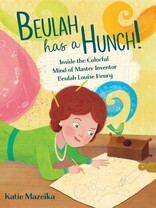 Beulah Has a Hunch!: Inside the Colorful Mind of Master Inventor Beulah Louise Henry. Katie Mazeika. (2023). Beach Lane. Katie Mazeika gives the reader a look into the unique mind of Beulah Louise Henry (1887-1973), the American who became known as “Lady Edison.” As a child, when she saw a problem, Beulah came up with a “hunch,” an idea for a new invention to solve it. She had hyperphantasia, the seeing of extreme details of things in one’s mind. This unusual ability helped her discover innovative solutions. She also had synesthesia, what she called “color hearing,” with words, numbers, and music notes appearing in different colors in her mind. Beulah became one of America’s most prolific inventors, holding patents for an array of things from fashionable Snappon parasols to cuddly stuffed animals to factory machinery, and was an astute businesswoman. Back matter for this inspiring biography complemented by colorful digital illustrations includes an extensive “More on Beulah Louise Henry” section, a timeline of a few of her inventions with patent drawings, and sources. (Gr 3-5)  The Life and Brilliance of the Woman Who Discovered What Stars Are Made Of. Kirsten W. Larson. Illus. by Katherine Roy. (2023). Chronicle. Kirsten W. Larson’s lyrical side-by-side narratives and Katherine Roy’s exquisite artwork, rendered in pencil and walnut ink with added digital color, depict the birth of a star and the life story of British-born Cecilia Payne (1900-1979) from growing up in the country curious about everything in nature, to graduating from Cambridge with a degree in physics, to coming to America and earning a Ph.D. in astronomy for her discovery that stars are mostly hydrogen and helium. Her solving of the mystery of what stars are made of led to more discoveries about stars at Harvard and recognition for her lifetime of excellence in astronomy research. Back matter includes further information on Cecilia Payne and the birth of a star, a timeline, and a bibliography. (Gr 3 Up) 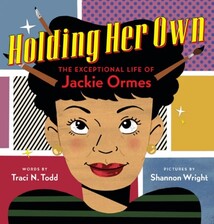 Holding Her Own: The Exceptional Life of Jackie Ormes. Traci N. Todd. Illus. by Shannon Wright. (2023). Orchard. Cartoonist Shannon Wright’s illustrations for this engaging picture book biography of Jackie Ormes (1911-1985), the first Black woman cartoonist to be nationally syndicated in the United States, are bold and rich with color, like Jackie herself. Jackie Ormes wore multiple hats including those of a journalist, philanthropist, fashionista, and activist. After getting her dream job of writing for the Black newspaper, the Pittsburgh Courier, and having her stories published in a column every Saturday, she began creating a comic strip about a Black Mississippi girl who confronts prejudice and fear in New York. Marrying and living in post-World War II Chicago, Jackie continued her civil right activism with fund-raising activities and support of Black people by sharing the inequalities they faced through her artwork, particularly a comic strip featuring a little girl named Patty-Jo. Back matter includes an extensive author’s note with photographs of Jackie Ormes and reproduction of several of her cartoons, an illustrator’s note, and a selected bibliography. (Gr 3-5) 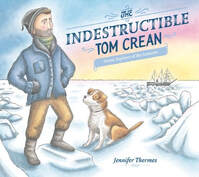 The Indestructible Tom Crean: Heroic Explorer of the Antarctic. Jennifer Thermes. (2023). Viking. Jennifer Thermes presents the story of Irish-born Tom Crean (1877-1938) with an accessible text that details seaman Crean’s adventures as a crewmember on three expeditions during the Heroic Age of Antarctic Exploration: the Discovery (1901-1904) under Captain Falcon Scott with the goal to explore Antarctica and make scientific discoveries; the Terra Nova (1910-1913) with the goal to be the first to reach the South Pole (Norwegian Roald Amundsen won the race; some of Scott’s crew also reached the pole, but Scott did not survive), and the Endurance (1914-1917) under Captain Ernest Shackleton with the goal of crossing the entire continent of Antarctica. Crean became a leader who motivated others with his courage and perseverance as they face hardships and tragedies. Captivating double-spread illustrations featuring panoramic views of the icy landscape, maps, and panels depicting the explorers’ activities enhance the story of Crean’s heroic deeds and adventures. The front endpaper features a map and facts about Antarctica; the back endpaper has portraits of animals of Antarctic. Back matter includes an afterword, a timeline, and sources. (Gr 3-5) 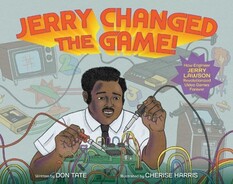 Jerry Changed the Game!: How Engineer Jerry Lawson Revolutionized Video Games Forever. Don Tate. Illus. by Cherise Harris. (2023). Paula Wiseman. This engaging picture book tells the life story of African American Gerald Anderson (Jerry) Lawson (1940-2011). As a boy growing up in Queens, New York, Jerry was obsessed with taking apart and playing with gadget-y things. As an adult, he became an engineer at Fairfield Semiconductor in Silicon Valley, in northern California. In 1976, he developed a home video game console that made it possible for players to switch out cartridges, an invention that revolutionized video gaming. He went on to found Video-Soft, Inc., the first African American video game company in the country. Video gamers everywhere have Jerry Lawson to thank for the accessibility of hundreds of games with the push of a button. Back matter includes an author’s note, an illustrator’s note, a timeline of the arcade and video game industry, a glossary, and a bibliography. (PreK Up) 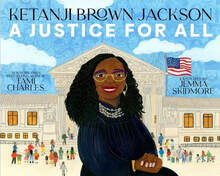 Ketanji Brown Jackson: A Justice for All. Tami Charles. Illus. by Jemma Skidmore. (2023). Simon & Schuster. On February 25, 2022, as he nominated Ketanji Brown Jackson to serve as an Associate Justice of the U.S. Supreme Court, President Joseph Biden said, “For too long, our government, our courts haven’t looked like America. . . . It’s time that we have a Court that reflects the full talents and greatness of our nation. . . .” With Tami Charles’s poetic words and Jemma Skidmore’s colorful, expressive illustrations rendered in gouache and wax pencil, this inspiring biography tells the story of the journey of “historymaker, barrier breaker” Justice Jackson (b. 1970) becoming the first Black woman to serve as an Associate Justice of the U.S. Supreme Court. The back matter includes an author’s note, a timeline, an “Important People and History in the Art” section, and a bibliography. (Gr 3 Up) 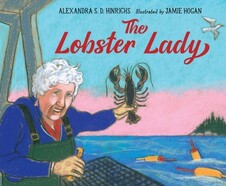 The Lobster Lady. Alexandra S. D. Hinrichs. Illus. by Jamie Hogan. (2023). Charlesbridge. This picture book biography of Virginia Oliver (b. 1920) is the story of the remarkable woman from Maine known as “The Lobster Lady,” who has been lobstering since the age of eight—and may be the oldest lobsterer in the world. Alexandra S. D. Hinrichs’s engaging text and Jamie Hogan’s colorful illustrations, done in chalk pastel on sanded paper, chronicle a day in Virginia’s life aboard the Virginia lobstering with Max, her son. The book also spotlights Virginia’s memories of growing up on The Neck, her family’s small island off St. Andrew’s Island, but having to stay with her aunts and grandfather on the mainland in Rockland, Maine, during school months and her adult life working at various unsatisfying jobs before deciding to work with her lobsterman husband. The fiercely independent Virginia Oliver still takes to the sea on her boat and has no plans to stop lobstering. Back matter includes a “Meet Virginia” section with additional biographical information, a “Changes and Challenges” note on the lobstering industry and community in Maine, Virginia’s simple recipes for a lobster roll and a bean supper, and sources. (PreK-Gr 2) 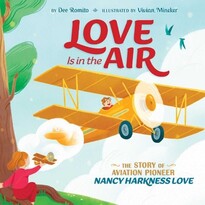 Love Is in the Air: The Story of Aviation Pioneer Nancy Harkness Love. Dee Romito. Illus. by Vivian Mineker. (2023). Aladdin. As a child, Nancy loved adventure and believed that girls could do anything they dreamed of. Nancy fell in love with flying after taking her first plane ride with a barnstormer pilot at the age of 16. She then attended aviation school and earned her private pilot’s license. During World War II, she served as a pilot in the Women’s Auxiliary Ferrying Squadron (WAFS), transferring planes from factories to military bases. She later was part of the new Women Airforce Service Pilots (WASP). Vivian Mineker adds colorful digital illustrations to this picture book biography of Nancy Harness Love (1914-1976). Back matter includes an author’s note with additional information about Love and her experiences as an aviation pioneer who paved the way for the female pilots who came after her, photographs, and sources. (PreK Up) 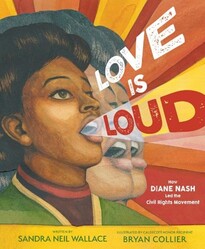 Love Is Loud: How Diane Nash Led the Civil Rights Movement. Sandra Neil Wallace. Illus. by Bryan Collier. (2023). Paula Wiseman. Diane Nash grew up in Chicago with parents who wanted her to know only love. She faced racism head on for the first time when she moved to Nashville, Tennessee, to attend Fisk University. Experiencing indignation at the unfair treatment of Black people, she was determined to work to end segregation with love. Diane participated in sit-ins, marches, and Freedom Rides. She became a prominent leader in the Civil Rights Movement, making changes with courage and love. “Love is fierce. Love is strong. Love is loud!” Sandra Neil Wallace’s use of powerful language with words such as DEFIANT, DETRMINED, COMPASSIONATE, and BRAVE highlighted in the moving text and Bryan Collier’s stunning watercolor-and-collage illustrations make this a beautifully crafted picture book biography of Diane Nash (b. 1938), who showed that there are “JUST and PEACEFUL, POWERFUL ways to create change.” Back matter includes an author’s note, an illustrator’s note, a timeline, video interviews, books for young readers, quote sources, and a selected bibliography. (PreK Up) 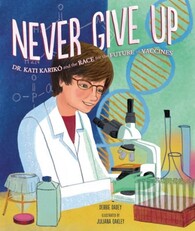 Never Give Up: Dr. Kati Karikó and the Race for the Future of Vaccines. Debbie Dadey. Illus. by Juliana Oakley. (2023). Millbrook. Never Give Up tells the inspiring story of Dr. Kati Karikó (b. 1955), the joint recipient of the 2023 Nobel Prize in Physiology or Medicine, who grew up on a farm in Hungary and at an early age decided she wanted to become a scientist. Earning a Ph.D. in biochemistry, Dr. Karikó’s research focused on messenger ribonucleic acid (mRNA), and after coming to the U.S. in 1985, she continued to work on its use in helping the body fight illnesses in spite of the lack of support of colleagues and research funding. In 1997, she began working with immunologist Dr. Drew Weissman to find a way to make mRNA “teach cells to create a specific virus protein.” The breakthrough came in 2005 with their publication of a paper on how mRNA could be used to make vaccines. This modified mRNA technology was used in producing the Pfizer-BioNTech COVID-19 vaccine— just what the world needed as a global pandemic was declared in 2020. Back matter includes a timeline, information on making vaccines, an author’s note, a glossary, source notes, and resources. (Gr 3 Up) Lynette Smith is a member of the Contributing Faculty for Walden University’s Richard W. Riley College of Education and Leadership.
0 Comments
Nancy Brashear and Carolyn Angus The picture book biographies reviewed in this column introduce readers of all ages to creative individuals who have made notable contributions in the visual, literary, and performing arts. Included are books that are great choices for reading aloud to spark interest and discussion in classrooms, libraries, and homes as well as for independent reading. 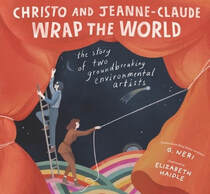 Christo and Jeanne-Claude Wrap the World: The Story of Two Groundbreaking Environmental Artists. G. Neri. Illus. by Elizabeth Haidle. (2023). Candlewick. Christo (1935-2020), a poor refugee from Eastern Europe, and Jeanne-Claude (1935-2009), the rich stepdaughter of a French general, met when Christo was commissioned to paint portraits of her family. After Christo shared his “wrapped art” (objects wrapped in cloth and rope) with her, she realized that it was “revealing—while concealing” and asked, “If you can wrap cans and bottles, why not wrap everything?” They fell in love and spent the rest of their lives together, wrapping and surrounding monuments, buildings, landscapes, and even an island with fabrics. Their public art installations included 23 finished projects, some that took decades to complete. For example, ”L’Arc de Triomphe, Wrapped” was begun in 1962 but not completed until 2021, a year after Christo’s death. Elizabeth Haidle’s stylized mixed-media artwork complements G. Neri’s text with real and imagined dialogue that expresses the collaboration of Christo and Jeanne-Claude whose realized environmental art enlivened the “What Is Art” question. Back matter includes additional biographical information, an author’s note, a collection of fun facts about the couple, and a bibliography (books, films, website). (PreK Up) —NB 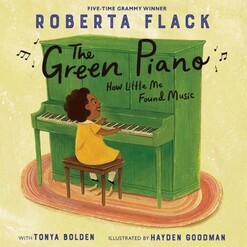 The Green Piano: How Little Me Found Music. Roberta Flack (with Tonya Bolden). Illus. by Hayden Goodman. (2023). Anne Schwartz. Through a simple lyrical text accompanied by Hayden Goodman’s joyous gouache paintings, singer Roberta Flack (b. 1937) tells the story of her childhood growing up in a musical family in the Blue Ridge Mountains in North Carolina and, later, Green Valley, Virginia. As a young child, she loved to sit at the piano in the church where her mother was the organist and pianist, imagining she was playing hymns to a congregation. “At age three, maybe four, / there was me / at the keys / of that church piano.” She dreamed of having her own piano one day. When her daddy found an old junkyard piano that he and her mother cleaned up, painted green, and gave to the nine-year-old Roberta, she was set on the path to achieving her even bigger dream: “Of a life / all wrapped up in / the majesty, / the magic / of music— / my treasure, / my gold.” Back matter of this soulful autobiography includes an author’s note with photographs and a timeline of career highlights. (PreK Up) —NB 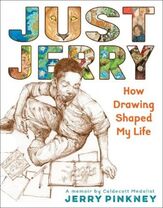 Just Jerry: How Drawing Shaped My Life. Jerry Pinkney. (2023). Little, Brown. In this moving memoir, Jerry Pinkney (1939-2021) tells of his post-World War II childhood experiences of growing up in a large, loving family on East Earlham Street, an all-Black block in Philadelphia. Jerry, who had school problems (unidentified dyslexia), was always drawing. Although drawing was the one thing he knew he was good at, dreaming of becoming an artist was not realistic. “And in the world in which I was living to be anything or go anywhere was not a dream that young Black boys often dared to have.” But, with encouragement from teachers and mentoring by newspaper comic-strip artist John Liney, who recognized his talents, Pinkney persisted in studying art and became one of the most celebrated children’s book illustrators of all time. The warm conversational tone of Pinkney’s narrative and the abundance of his rough sketchbook drawings makes Just Jerry a book to treasure along with all of his classic picture books (the covers of a few of these are shown in the “What Happened Next” epilogue). Back matter includes a timeline of key dates in Pinkney’s life and select accomplishments. (Gr 3 Up) —CA 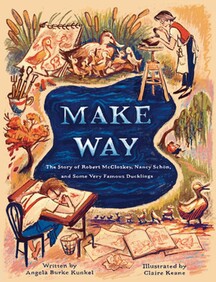 Make Way: The Story of Robert McCloskey, Nancy Schön, and Some Very Famous Ducklings. Angela Burke Kunkel. Illus. by Claire Keane. (2023). Random House Studio. As a child, Robert McCloskey (1914-2003) carved and painted. Later, after studying art in Boston, he was told by a children’s book editor in New York City “not to be so serious.” Remembering feeding the ducks at the Boston Public Garden, McCloskey began an extensive study of mallards that resulted in his sepia-toned drawings in Make Way for Ducklings (1941). Nancy Schön (b. 1928) used art to escape being bullied at school. As an adult, after hearing about a child asking, “Mommy, where are the ducks?” on a visit to the Public Garden, she was inspired to sculpt a miniature parade of the ducks from Make Way for Ducklings. Learning about her project, McCloskey came to Boston to see it and, with his approval, Nancy Schön shaped and cast in bronze Mrs. Mallard and her eight ducklings. Claire Keane’s nostalgic digital illustrations match perfectly with Angela Burke Kunkel’s inviting text in this biography of McLCloskey, Schön. and the very famous ducklings that were installed in the Boston Public Garden in 1987. Back matter includes an author’s note with photos, a timeline, and a selected bibliography. (PreK Up) —NB 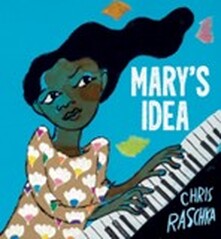 Mary’s Idea. Chris Raschka. (2023). Greenwillow. In his always innovative fashion, Chris Raschka creates an evocative ode to jazz pianist and composer Mary Lou Williams (1920-1981). Artwork rendered in ink, oil pastel, and watercolor on a brown textured background features Mary’s hands, a keyboard, sheet music, and colorful swirls of music. The simple lyrical text with only a few words on each double-spread page and a repetition of the phrase “It was Mary’s idea” presents the life story of Mary from child prodigy to legendary jazz musician. “It was Mary’s idea to play // the piano at three. // It was Mary’s idea // to play the piano for me.” Mary always made her own decisions, including to stop playing the piano for a time before beginning her career again. “It was Mary’s idea // to start again, for people, for God, and me.” Back matter includes additional biographical information and a thought-provoking quote. (PreK Up) —CA 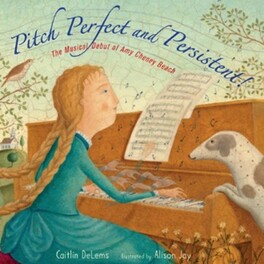 Pitch Perfect and Persistent!: The Musical Debut of Amy Cheney Beach. Caitlin DeLems. Illus. by Alison Jay. (2023). Calkins Creek. Amy Cheney Beach (1867-1944), the first successful woman composer in America, was born into a musical family, but when she sang an anthem with perfect pitch to the delight of a gathering of relatives and friends at age two, her strict, religious mother was worried. She wanted Amy to be a normal child. “No indulgence. No spectacle. And certainly, no piano!” Caitlin DeLems’s engaging text describing the little girl’s persistence in wanting to hear, think, and play music, which won out with the help of her aunt who put four-year-old Amy up on the piano bench, is complemented by Alison Jay’s distinctive artwork done with a quick-drying oil paint with crackle varnish. This engaging biography follows Amy through her music-filled childhood to her piano debut with a symphony at the Boston Music Hall at age 16 (Mamma consents reasoning it might help Amy attract a husband), which proved to be the beginning of her breaking the glass ceiling for women musicians and composers. Back matter includes an author’s note (with photographs), timeline, musical glossary, selected bibliography, and a “To Learn More About Amy Beach” section of websites and places to visit. —NB 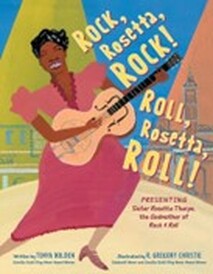 Rock, Rosetta, Rock! Roll, Rosetta, Roll!: Presenting Sister Rosetta Tharpe, the Godmother of Rock & Roll. Tonya Bolden. Illus. by R. Gregory Christie. (2023). Harper. Rosetta, a little girl “making downright mighty music, music, music” with a big guitar in tiny Cotton Plant, Arkansas, moved with her mother to Chicago where she “played, played, played” and had people clapping their hands, stamping their feet, and shouting as Mama preached in churches, at outside revivals, and on street corners. This little girl also had a big voice and began “belting out the rhythm-bound Gospel sound.” As an adult, Rosetta mixed Gospel music with boogie-woogie, jazz, swing, and the blues. She took her music into nightclubs including New York City’s Cotton Club, cut records for Decca, performed at Harlem’s Apollo Theater, had a concert at Carnegie Hall, and did a European tour. She “played, played, played--and sang! / as the fabulous, / flamboyant / Sister Rosetta Tharpe!” Tonya Bolden’s lively free verse text and R. Gregory Christie’s vibrant acrylic artwork full of movement create a fitting tribute to Sister Rosetta Tharpe (1915-1973), the godmother of rock and roll. Back matter includes a timeline, author’s note, and sources. (PreK Up) —CA 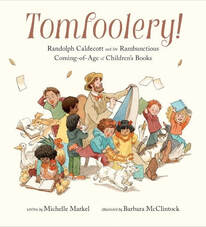 Tomfoolery!: Randolph Caldecott and the Rambunctious Coming-of-Age of Children’s Books. Michelle Markel. Illus. by Barbara McClintock. (2023). Chronicle. In the 1850s, children’s books had pictures that were “stiff, full of pretty poses and cluttered scenery.” But Randolph Caldecott (1946-1886), who filled his sketchbook with drawings of playful animals as a child in Chester, England, grew up to become the artist who transformed picture books forever: “No frilly lines, no fussy background, no crowded pages—scene by scene the story tumbles forth like life.” Michelle Markel’s text is descriptive, lively, and child friendly. “He dips his nib in the ink . . . and TALLYHO!” Barbara McClintock’s artwork completes this beautifully designed biography of Randolph Caldecott. Some of the double-page spreads include reproductions of Caldecott’s drawings, and there is a full-color wordless spread of an illustration from The Diverting History of John Gilpin (1878). Back matter includes an identification of the reproductions of Caldecott’s own art and the pages on which they appear in Tomfoolery; annotations; notes on illustrated Victorian periodicals and the “big three” of toy book illustrators: Walter Crane, Randolph Caldecott, and Kate Greenaway; Caldecott’s picture books listed by publication date; and a bibliography (books and articles). (PreK Up) —CA 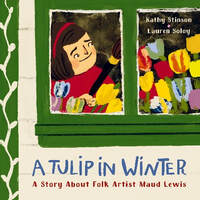 A Tulip in Winter: A Story About Folk Artist Maud Lewis. Kathy Stinson. Illus. by Lauren Soloy. (2023). Greystone Kids. Canadian folk artist Maud Lewis (1903-1970) struggled cheerfully throughout her life with undiagnosed rheumatoid arthritis, which kept her small, affected her mobility, and caused her fingers and joints to swell. Once her mother gave Maud a paintbrush, however, she began to create colorful nature scenes. After the death of her parents, she was penniless and moved in with an aunt who wouldn’t let her paint (“Too messy”), so she left to become a live-in housekeeper (and, later, wife) to fish peddler Everett Lewis, who didn’t care about her physical limitations. Using leftover paint he scrounged from the dump and wharf, Maud transformed their tiny home into a work of art. Together, they sold fish and Maud’s nature creations painted on everything from trays to scraps of wood. Eventually her arthritis made it too difficult to walk or paint, and Everett pushed her in his wheelbarrow. Tiny Maud was buried in a child’s coffin, and their cottage is now housed inside the Art Gallery of Nova Scotia. Kathy Stinson’s lyrical text pairs beautifully with Lauren Soloy’s colorful, stylistic folk art. Back matter includes additional biographical information and notes from the author and illustrator. (PreK Up) —NB 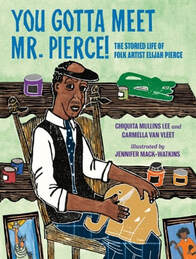 You Gotta Meet Mr. Pierce!: The Storied Life of Folk Artist Elijah Pierce. Chiquita Mullins Lee & Carmella Van Vleet. Illus. by Jennifer Mack-Watkins. (2023). Kokila. When a father takes his young son for a haircut at Elijah Pierce’s barbershop in Columbus, Ohio, he tells him, “You Gotta Meet Mr. Pierce!” While waiting for his turn, the boy draws with his new set of colored pencils, and Mr. Pierce shares how his uncle gave him a pocketknife and taught him to carve. He says, “I would turn wood into stories” and takes him on a tour of the wood art decorating the walls of his shop. The boy leaves the barbershop with an elephant Mr. Pierce has carved for him from a chunk of wood and is full of ideas for his own art projects. Chiquita Mullins Lee and Carmella Van Vleet’s engaging narrative for this picture book biography of African American folk artist Elijah Pierce (1892-1984) is accompanied by Jennifer Mack-Watkins’s vibrant illustrations done with Japanese woodblocks that incorporate collaged photographs of pieces of Elijah’s art. Back matter includes additional information on Elijah Pierce’s life, folk art, and honors; notes from the authors; and sections on where to see his work on exhibit and detailed information about Pierce’s art appearing in this book (PreK Up) —NB Nancy Brashear is Professor Emeritus of English at Azusa Pacific University, in Azusa, California. Carolyn Angus is former Director of the George G. Stone Center for Children’s Books, Claremont Graduate University, in Claremont, California.
Chelsey Bahlmann Bollinger & Carolyn Angus The picture book biographies reviewed in this column introduce readers of all ages to creative individuals who have made notable contributions in the visual, literary, and performing arts. Included are books that are great choices for reading aloud to spark interest and discussion in classrooms, libraries, and homes as well as for independent reading. 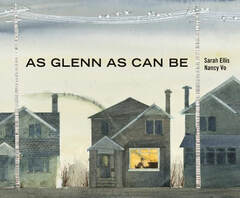 As Glenn as Can Be. Sarah Ellis. Illus. by Nancy Vo. (2022). Groundwood. This intriguing picture book biography showcases Canadian child prodigy and celebrated composer and classical pianist Glenn Gould (1932-1982). The dust jacket and book cover and the front and back endpapers present strikingly contrasting images that complement Sarah Ellis’ rhythmic narrative in which she describes Glenn Gould’s likes and dislikes of just about everything as both a child and adult. For example, he liked to learn things, but disliked school, and he loved playing the piano, but hated giving concerts. Ellis’ text clearly presents Gould as an eccentric who wanted to make music in his own way. Back matter includes an author’s note, books for further reading, and information about listening to some of Gould’s famous recordings. As Glen as Can Be encourages children to accept others and to identify their own perceptions of the world and to understand how they fit within it. —CBB 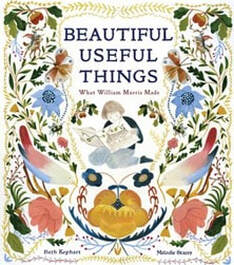 Beautiful Useful Things: What William Morris Made. Beth Kephart. Illus. by Melodie Stacey. (2022). Cameron Kids. This beautifully designed book examines the life and work of William Morris (1834-1896), who wanted to honor the beauty of nature that he loved as a child by “making beautiful useful things” as an adult. A key figure of the Arts and Crafts Movement in Great Britain, Morris designed textiles, wallpaper, tapestry, rugs, stained-glass windows, and other handmade works of art featuring patterns from nature while factories were producing cheap, utilitarian things. Near the end of his life, Morris also created beautiful books, handcrafted one at a time. Back matter for this biography with a lyrical text and illustrations inspired by William Morris’ designs includes an image of Strawberry Thief, one of Morris’ fabrics with a motif of birds, flowers, and fruit; an author’s note; an illustrator’s note; and sources. —CA 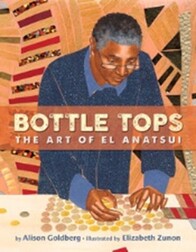 Bottle Tops: The Art of El Anatsui. Alison Goldberg. Illus. by Elizabeth Zunon. (2022). Lee & Low. Ghanaian artist El Anatsui (b. 1944) creates works of art from used objects, “materials with a history.” He believes, “If you touch something, you leave a charge on it and anybody else touching it connects with you, in a way.” Alison Goldberg’s engaging text and Elizabeth Zunon’s colorful illustrations rendered in paint and cut-paper collage show the involved process El Anatsui follows in creating bottle top sculptures, his most famous works of art that can be seen all over the world. Back matter includes a double-page spread with photographs of El Anatsui and two of his sculptures, text sources, quotation sources, identification of featured artwork, and an art activity using recycled materials. This would be a great book to read aloud in art class or when discussing reducing, reusing, and recycling. —CBB 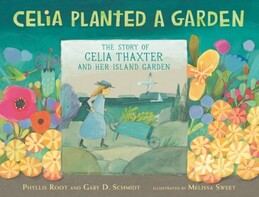 Celia Planted a Garden: The Story Celia Thaxter and Her Island Garden. Phyllis Root & Gary D. Schmidt. Illus. by Melissa Sweet. (2022). Candlewick. The life story of poet Celia Laighton Thaxter (1835-1894) is presented in this picture book biography in which lines from her writing are featured. “The very act of planting a seed in the earth has in it to me something beautiful.” Melissa Sweet’s colorful illustration done in watercolor, gouache, and mixed media encourage the reader to examine and appreciate the beauty of the floral blossoms, birds, fish, and even the storms off the coast of Maine where Celia created island gardens as a child and an adult. Back matter includes a note on Celia Laighton Thaxter, a timeline listing the publications of her numerous poetry collections and detailing both the highlights and harsher realities of her life, and a bibliography. —CBB 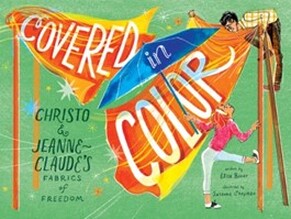 Covered in Color: Christo & Jeanne-Claude’s Fabrics of Freedom. Elisa Boxer. Illus. by Susanna Chapman. (2022). Abrams. Covered in Color celebrates the artistic genius of Bulgarian-born Christo (1935-2020), who grew up under Nazi occupation and then Communist control. In art school, he resisted the rigid rules that forced artists to paint propaganda and, at the age of 21, he fled to France where he began to create imaginative sculptures. Christo met and married Jeanne-Claude (1935-2009) in Paris, and the couple moved to New York City. A lively text and stunning mixed-media illustrations detail how they worked together to create the public art installations they became known for by wrapping and surrounding monuments, buildings, coast lines, and even islands with colorful fabrics. Back matter includes an extensive author’s note; an artist’s note; captioned photographic images of The Gates (February 2005, New York City) and L’Arc de Triomphe (September 2021, Paris); notes on quotations; and selected sources. —CA 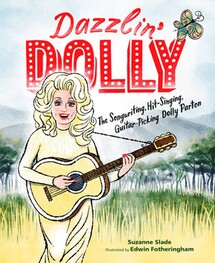 Dazzlin’ Dolly: The Songwriting, Hit-Singing, Guitar-Picking Dolly Parton. Suzanne Slade. Illus. by Edwin Fotheringham. (2022). Calkins Creek. Dolly Parton’s life story is presented in this biography written in a folksy, Southern dialect. Born into a poor family in the Tennessee mountains, Dolly Parton (b. 1946) used the gifts she was born with to become an award-winning country music star and a philanthropist. Edwin Fotheringham’s digitally created illustrations focus on key events in her childhood and early career. Throughout the book, Dolly talks about a bully called “stage fright.” She says that she “squashed that stage fright like a pesky June bug.” Young readers may be unfamiliar with this popular musician, but her life story may inspire them to follow their own dreams despite roadblocks in their lives. The back matter includes a timeline that includes the mention of some of her songs; an end note; and a bibliography of books, videos, websites, audio, and newspaper/magazine articles. —CBB 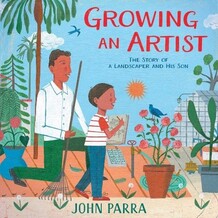 Growing an Artist: The Story of a Landscaper and His Son. John Parra. (2022). Paula Wiseman. In this autobiographical picture book, John Parra tells the story of his childhood experience of spending a day working with his papi, a landscape contractor, and his helper, Javier, mowing, trimming, and raking in a yard; selecting plants at a nursery; taking clippings and branches to the dump; and making plans for landscaping a client’s overgrown yard. Although John is bothered by being ignored when he waves to a classmate who is watching them working in his neighbor’s yard, he learns that his father loves his work and is proud of it. This experience makes John determined “to use his art to tell the stories of hardworking, passionate people who make the world more beautiful.” The endpapers for Parra’s memoir with colorful, detailed illustrations created with acrylic paints are blueprints of a landscape design. Also available as Cultivando a un artista (2022). —CBB 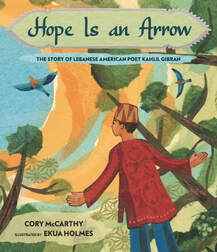 Hope Is an Arrow: The Story of Lebanese American Poet Kahlil Gibran. Cory McCarthy. Illus. by Ekua Holmes. (2022). Candlewick. As an Arab child growing up in Lebanon, Gibran Kahlil Gibran was aware of the religious conflicts that divided the country; as an immigrant living in Boston with his mother and three siblings, he saw the division between the wealthy and the poor in America. His “secret hope” was to find a way of guiding people to come together through love and understanding in spite of their differences. As Cory McCarthy eloquently states, “Kahlil Gibran became an arrow shot true, an arrow made from the strength of Lebanese cedars and feathered by the spirit of American,” when he shared his message in The Prophet (1923). Ekua Holmes’ vibrant collage-and-acrylic artwork complements McCarthy’s poetic prose that incorporates quotes from Khalil Gibran. Back matter includes a source note, additional stories from Gibran’s life, and a bibliography. —CA 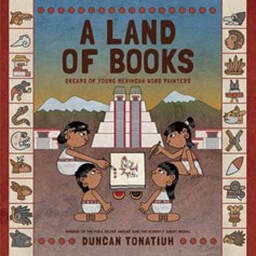 A Land of Books: Dreams of Young Mexicah Word Painters. Duncan Tonatiuh. (2022). Abrams. With hand-drawn, digitally collaged artwork inspired by Mesoamerican codices and a lyrical prose that includes Nahuatl words, Duncan Tonatiuh celebrates the importance of books in preserving Indigenous languages, stories, and traditions. “Our world, my brother, is an amoxtlalpan [a land of books],” says a Mexicah girl who is telling him about the important work of their parents as tlahcuilohqueh, painters of words. She explains to her brother (and to readers) their parents’ step-by-step creation of amoxtin, books that tell the stories of their god, people, and history, and says that they should dream about these amoxtin as they sleep and anticipate attending the flower festival where the villagers will be able to look at a book, an amoxtli, and hear a reader sing the words their parents painted. Back matter includes a glossary (with pronunciation guide, an extensive author’s note, a bibliography, and websites. —CA 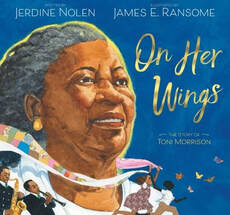 On Her Wings: The Story of Toni Morrison. Jerdine Nolen. Illus. by James E. Ransome. (2022). Paula Wiseman. Jerdine Nolen tells the life story of Toni Morrison (1931-2019), the first African American woman to be awarded the Nobel Prize for Literature (in 1993), who was born Chloe Ardelia Wofford and took the nickname Toni when she was a student at Howard University. While working as an editor in New York, she began writing stories “about her people, Black people.” Her first novel, The Bluest Eye, was published in 1970. Toni Morrison’s storytelling power is reflected in her many novels for adults and books for children (written with her son, Slade Morrison). James E. Ransome incorporates portraits of Morrison as she aged in his expressive watercolor-and-collage illustrations. Back matter includes an author’s note and an extensive “Learn More About Toni Morrison” section (her books, quotes, films and videos, articles of interest, and a timeline of selected achievements and information). —CA 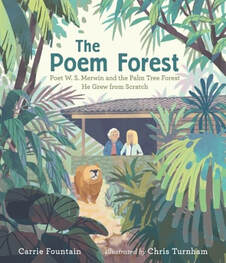 The Poem Forest: Poet W. S. Merwin and the Palm Tree Forest He Grew from Scratch. Carrie Fountain Illus. by Chris Turnham. (2022). Candlewick. Carrie Fountain’s lyrical narrative complemented by Chris Turnham’s expressive, digitally created artwork tells the life story of prolific poet W. S. Merwin (1927-2019), who won two Pulitzer Prizes and was named the Poet Laureate of the United States in 2010. William Stanley didn’t like things “straightened out.” For him, “writing poetry was like visiting a wild place.” Eventually moving to Hawaii, William Stanley found a spot in Maui that was labeled a wasteland but for him was “a straightened-out place longing to grow wild.” He planted a palm tree every day during the rainy season to heal the earth. Eventually he and his wife created a conservancy abundant with a wide variety of palm trees, including endangered species from around the world. The Merwin Conservancy became a place that “will never be straightened out.” Back matter includes an author’s note and W. S. Merwin’s poem, “Palm.” —CBB 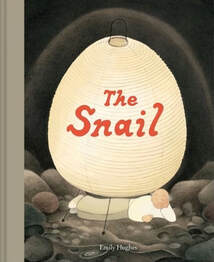 The Snail. Emily Hughes. (2022). Chronicle. “Isamu was American; / Isamu was Japanese. / Isamu was an artist. / As an artist, he wanted to give gifts to the world.” Emily Hughes pays tribute to Isamu Noguchi (1904-1998), who felt he was an outsider in both countries. He had homes in New York City and in Mure, Japan, but thought of himself as a snail, living in his shell. When his two countries were at war, he felt neither American nor Japanese and resolved to be an artist only. With an exquisite combination of words and images, Hughes tells the story of Isamu Noguchi brilliance as a sculptor. Using different materials, he created works of art from large public installations to delicate miniature pieces. She provides a richly detailed account of Noguchi’s akari, “sculptures that held light within” and ends her author’s note with the words, “When Isamu made akari, he gave us a gift of love.” —CA Chelsey Bahlmann Bollinger is an assistant professor in the Early, Elementary, and Reading Department of James Madison University in Harrisonburg, Virginia. Carolyn Angus is former Director of the George G. Stone Center for Children’s Books, Claremont Graduate University, in Claremont, California.
|
AuthorsThese reviews are submitted by members of the International Literacy Association's Children's Literature and Reading Special Interest Group (CL/R SIG). Categories
All
Archives
August 2026
|
 RSS Feed